|
|
 |
 |
|
ROBERT WILLIAMS BUCHANAN (1841 - 1901)
|
 |
 |
|
SITE DIARY
6 September 2026
Harriett Jay’s Novels
Which I don’t mention that often but an interesting item turned up regarding The Priest’s Blessing which I thought I should draw attention to here, rather than leaving it as a footnote on the relevant page. Here’s the note:
(Note: I have no evidence that the career of Father Joseph Foy was the model for Jay’s drunken curate, “Father Flannigan”, but I recently (July, 2026) came across this description of the former, in Fifty Killala Priests 1600 - 2000 by Brendan Hoban: Chapter 17. Joseph Foy ‘Miracle Worker’. Although I’m not sure whether the dates tally - Buchanan left Ireland around October 1877 - footnote No. 22 does mention Rossport and Father John Melvin, to whom Buchanan did dedicate his own novel, Father Anthony. I thought it worth mentioning because it does seem to add a degree of authenticity to Jay’s novel, or at the very least mitigates those reviews which took exception to the descriptions of such a priest.)
And this is a very odd edition of Through the Stage Door which turned up on ebay.
|
 |
 |
|
 |
|
 |
|
|
|
Here’s the ebay blurb:
‘The Buttercup Library – Through the Stage Door by Harriett Jay is an appealing and uncommon c.1898 promotional hardback issued by the Chiswick Soap Company as part of their wellknown Victorian advertising campaign. Presented in a decorative olivegreen cloth binding with bright buttercup motifs, this volume is both a piece of literary history and a fine example of lateVictorian marketing design.
This firstedition Buttercup Library issue contains Jay’s theatrical novel Through the Stage Door, a lively exploration of backstage life, performance culture, and the world of the Victorian stage. Jay—an established novelist and playwright—was known for her vivid portrayals of theatre, women’s roles, and the social atmosphere of the period, making this an engaging and culturally rich text.
As a promotional publication created to advertise Chiswick Soap Co.’s metal polish and household products, the book offers a fascinating glimpse into turn-of-the-century advertising practices, where literature and branding were combined to attract customers. Its blend of English theatrical fiction and Victorian commercial ephemera gives it strong appeal for collectors of advertising history, vintage publishing, and 19thcentury literature.
A charming and unusual collectible, this Buttercup Library edition stands out for its decorative design, its connection to Victorian advertising culture, and its inclusion of Harriett Jay’s evocative theatrical narrative.’
|
|
|
 |
|
|
|
 |
|
|
|
 |
|
|
|
Marjorie
I’ve always ignored the work Buchanan did on Marjorie, since he himself dismissed his contribution in a letter to The Era (25 January, 1890):
Sir,—I observe that it is stated, in several criticisms of the new opera Marjorie, that I am responsible for all the “new matter” in it, and particularly for the third act. This is not the case. It is true that I was requested to revise the libretto, and that I did so to the best of my ability; but only a very small portion of my work was utilised, and the third act more particularly was constructed and arranged by another hand. I do not say this to deprecate connection with a revision which was admirably and successfully done, though not by me, but to give honour where honour is due. The slight opposition provoked on the first night by one episode was caused by a small minority of not altogether disinterested spectators. The opera, as a whole, was received with generous enthusiasm. I am, &c., ROBERT BUCHANAN.
However, I came across the following review in The Star (20 January, 1890):
A description of the plot of “Marjorie” it would bore you to read—and me to write. Since the opera was produced at a matinée last summer, the book has undergone wholesale revision, and the responsibility for the alterations, particularly for the (practically) new third act, is understood to rest with Mr, Robert Buchanan. A pretty muddle Mr Buchanan has made of his task. The chief scene in this third act is based on an idea which might, conceivably, in competent hands—say Mr. Gilbert’s—be extremely diverting. The Earl of Chestermere, a self-willed Don Giovanni in chain armor (the action passes A.D. 1217) thinks to extricate himself from the imbroglio into which his own peccadilloes have brought him by
LOCKING UP ALL HIS COMPANIONS.
“I will show you,” he says, “what a knight of the thirteenth century can do if he chooses.” Thereupon all his household wife, sister, retainers, are hurried off one after another to the castle dungeon, until he remains in sole possession of the stage. So clumsily is this scene worked out that the house on Saturday mercilessly jeered at the whole business, and what might have been a strong scene came near to imperilling the fortune of the piece.
It struck me that, even if Buchanan had not done the revision, this might have given him the idea for what ultimately became When Knights Were Bold, especially considering the publication the previous year of Mark Twain’s A Connecticut Yankee in King Arthur’s Court.
___
The Ballad of Judas Iscariot by Robert Buchanan (London: The Old Stile Press, 1982. Limited edition of 100 copies).
No. 29 of the limited edition is, at the time of writing, available on ebay for the princely sum of $160. Too rich for my blood, but here are a few pictures. |
 |
|
|
 |
 |
 |
 |
 |
 |
 |
|
 |
|
 |
|
|
|
|
 |
|
 |
|
|
|
|
HMS Victory
I visited Portsmouth a few weeks ago, mainly in order to see HMS Victory. It’s on land, in a big warehouse and currently surrounded by scaffolding for a major renovation, so you don’t really get a sense of what it looks like from the outside or how big it is. Except you can go inside and by the time you’ve walked up and down the decks and negotiated all the stairs, you do understand how it could have carried nearly a thousand crew, which was my main reason for going to see it. In all the Hornblower and pirate films it always looks like there are only thirty-odd sailors on board, so when I read somewhere that the Victory carried over 800, I didn’t believe it. Anyway, I thought I’d add a couple of photos here in relation to the late Buchanan/Jay play, The Mariners of England, which featured a tableaux of the death of Nelson, which (after Buchanan and Jay had taken their names off it since it was being treated as jingo fodder for the Boer War), was extracted and ended up touring the music halls. Here’s the plaque which marks the spot where Nelson fell, struck by a sniper’s bullet, the place below decks to which he was taken and where he died (the blurred effect is not due to my emotional state, more the fact that you couldn’t use flash and I kept snapping things, rather than taking my time) and a photo of the steering wheel.
|
|
 |
|
|
 |
 |
|
|
 |
 |
|
|
 |
 |
 |
 |
 |
|
We also visited the Mary Rose where I didn’t take any photographs due to my Catholic upbringing and distaste for the precursor of Trump. I have to admit though that it is a very impressive exhibition.
___
12 June 2026
Just a quick update to mention a couple of things, let’s say, vaguely related to Robert Buchanan.
1. Irene Mawer
It’s a few years since I mentioned receiving an email from Janet Fizz Curtis about the mime and movement teacher, Irene Mawer, a name that was totally unknown to me. Janet was trying to find information about the inscription on Irene Mawer’s memorial plaque at Oxford Crematorium. It read. “All that is beautiful shall abide”, which, of course is a line from Buchanan’s Balder the Beautiful. At the time Janet was working on a wikipedia page for Irene Mawer, but this has now blossomed into a book.
|
|
|
|
 |
|
|
It’s available from Amazon or direct from Janet’s website, where it’s cheaper. This is for the electronic version or you can wait for the print copy to appear at the end of the year. There’s a short section on Robert Buchanan and Balder, and I get a mention (yay!)
___
2. Rudolf Blind
Oh, not again, you cry, but this is very strange. I received an email, not this time from a Blind descendant, but from someone who owns one of Blind’s most famous paintinga (although, unfortunately not the one that brought Buchanan into the Blind saga), ‘The Throne of Grace’. It’s not in good condition and needs restoration work, but the oddest thing is its location, on the island of St. John in the Virgin Islands! Here it is:
|
|
 |
|
|
 |
 |
 |
 |
|
 |
 |
|
Not my cup of tea, I must admit, and, I’m writing this having just heard that David Hockney died yesterday and I’m remembering one of his large (very large) pictures of trees in the York Art Gallery, which was absolutely stunning. But I am fascinated by how Blind’s painting ended up in the Caribbean and hopefully, at some point I’ll get another email with the explanation. In the meantime, I’ve added a new page to the Rudolf Blind section of the site:
‘The Throne of Grace’
_____
15 May 2026
Right, that’s The Star done. As well as the complete Wilde letters, I also found a lot of other stuff, including the letter which sparked Buchanan’s banning from The Daily Chronicle. There’s also the mystery of Buchanan’s final letter to The Star and who finally provoked his wrath (I think it’s too far to say his stroke) and I was hoping it was Lillie Langtry, but I think it was just a reviewer from The Daily News. I also came across the complete poem about the Jameson Raid, which is available here, along with the version by the Poet Laureate (Alfred Austin). In the same vein, there’s a poem called ‘On The Road To Khartoum’, which is unsigned, but follows a letter from Buchanan on the subject of ‘Christianity Up To Date’. I have added the poem after the letter, but, although it is in Buchanan’s style, I can’t verify it.
Another thing which turned up in April was a copy of Buchanan’s ‘final’ novel, The Peep-O-Day Boy: A Story of the Ninety-Eight, published posthumously by John Dicks in 1902. It was on ebay for £75 but there were no takers. More photos of pages from the book are available here.
|
|
|
 |
|
|
|
A couple of non-Buchanan related items turned up. A story about “The Lady Footballers” in The Star of 24th April, 1895. And this from the issue of 21st September, 1898:
|
|
|
 |
|
|
Which I only mention because I am reminded of the time I paid my sixpence (seems a bit much, maybe just a thrupenny bit) to see the Two-Headed Boy at a travelling fairground up Hanley. When I got in the tent I found a small stone (?) statue of a boy with another head stuck on its neck - badly done too, with no attempt to conceal the sellotape. I learnt my lesson.
_____
10 March 2026
The Daily Chronicle 2
I was hoping to do this last year, but the British Library Newspaper Archive had another special offer and since I’d found a few things missing in my last trawl, I set our to sea again, which meant I put off this update. I was coming to the end of the material from The Daily Chronicle, at least Buchanan’s letters, when the BLNA posted pages from The Star, and had another special offer. Now, I’ve been waiting for The Star to appear for a long time, for it’s that paper which contains Buchanan’s support for Oscar Wilde. Until now these letters were on the site in a truncated form, culled from books. Now I could get the originals, plus the letter about the review of Jude the Obscure in The Daily Chronicle, which Buchanan sent to The Star and which subsequently got him banned from The Daily Chronicle. Which would mean another long delay before posting an update and adding all the new material to the site. So, I thought I’d do this now before attacking the stuff from The Star.
As I said, most of the new material is from The Daily Chronicle and mostly features more of Buchanan’s letters to that paper. The main topics being:
Is Literature Played Out? and Literature and Lucre
Vizetelly and Zola
The Rewards of Literature
The Censorship of the Stage
And another ‘discussion’ which I came across in The Westminster Budget
The New Fiction
The only other major addition to the site concerns the painter, Rudolf Blind. The tale is told, about halfway down the particular page, about several descendants of Rudolf who have been in touch with me lately. It turns out that most of these are Canadian and it seems that my page, which is only there because Buchanan tried to buy one of his paintings and it was then mentioned in his bankruptcy proceedings, is the go-to source for information about Rudolf Blind. I could make a Biblical reference here, but I choose not to.
I apologise for the sketchy nature of this update, but, as I say I’m anxious to get to the material from The Star, and, besides my computer which is on its last legs, crashed for no apparent reason four times while I was trying to get this done. So, fingers crossed for the actual uploading process!
_____
5 August 2025
The Daily Chronicle 1
I went on the British Library Newspaper Archive site again since they had updated their Daily Chronicle scans and were now in the period which concerned Robert Buchanan. It meant that I could revise the section, ‘The Wandering Jew Controversy’. Originally this had been taken from photocopies of cuttings from the relevant pages held by the Liverpool Record Office, which had them in its Richard Le Gallienne archive. The controversy ran during January 1893, and I had to leave a lot of the letters out. Now I’ve added pdfs of the actual pages from the Chronicle (apart from one date, which is missing) and have finally been able to complete Richard Le Gallienne’s original review of The Wandering Jew which kicked the whole thing off. I also found that the controversy extended beyond the final cutting from Liverpool and discovered some more letters from Buchanan (I think he was trying to keep the controversy going in order to seel more copies of the poem).
The (revised) Wandering Jew Controversy.
There’s a lot more from The Daily Chronicle, which I will be adding soon. But, for now, as well as The Wandering Jew, there was the matter of Ibsen. There are two ‘new’ letters from Buchanan (I was making do with extracts from other papers) in the Letters to the Press section. There’s a long letter in response to the poor reviews for The Sixth Commandment, headed “RUSSIA AS IT IS.” And the full letter headed, “THE ROYAL PREROGATIVE OF MERCY”, about the Rayner and Eggleton Case.
And a couple of random items from the Chronicle:
The Daily Chronicle (11 October, 1890 - p. 4)
With five playwrights supplying at the present time no fewer than ten West-end theatres with the staple entertainment, there would appear to be room for other capable dramatic authors could shrewd managers discover them. Mr. Robert Buchanan, whose name until a few years back only fitfully appeared on London playbills, is responsible either wholly or in part for four dramas. He has “Sweet Nancy,” with which the Royalty has just reopened, and “The Sixth Commandment” at the Shaftesbury, besides joining Mr. Sims in “The English Rose” at the Adelphi, and Mr. Horner in “The Struggle For Life” at the Avenue. Next Monday he will have a fifth play running in London in “A Man’s Shadow” at the Grand. Mr. Grundy has two pieces now before the metropolitan public, “A Village Priest” at the Haymarket, and “A Pair of Spectacles” at the Garrick. Mr. Pinero is represented by “Sweet Lavender” (Terry’s) and “The Cabinet Minister” (Court). Messrs. Sims and Pettitt also have shares in two pieces each. They are united at the Gaiety with “Carmen Up To Data,” and are respectively interested in the Adelphi and Drury Lane (“A Million of Money”) performances.
___
And no connection to Robert Buchanan whatsoever.
The Daily Chronicle (10 April, 1882 - p.7)
|
|
|
 |
|
|
|
Ireland
In May I went to Ireland on holiday, Dublin, then Galway, and I took the opportunity to visit County Mayo and the area around the town of Belmullet, where the Buchanans lived for roughly four years, between the autumns of 1873 and 1877. I didn’t make it to Rossport, since nothing remains of Buchanan’s house or the estate it belonged to, but I’ve added some photos of the area to a page in the Miscellanea section.
‘What I did on my holidays (2). A Trip to Belmullet in Ireland.’
_____
26 March 2025
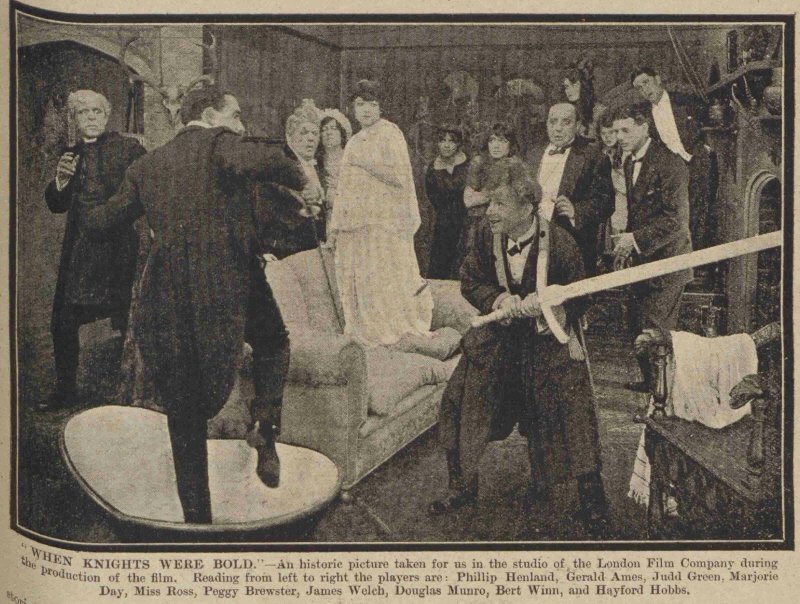
I meant to do this earlier in the year, just to show I’m still here, but life intrudes and now it’s my birthday this weekend, so I thought I’d just pop my head in the door. There’s not a lot to report. I’ve mainly been adding odd things from the last time I trawled the British Library Newspaper Archive and that’s mainly from the pages of Picturegoer. Including an article about the 1916 silent version of When Knights Were Bold starring James Welch.
|
 |
|
|
 |
 |
 |
|
And there’s additional material about the 1929 and 1936 versions. All available in the When Knights Were Bold Film section. Also, staying with When Knights Were Bold, which seems to be the gift which keeps on giving, I came across some photos of the members of the cast of the 1908 Swedish version. The nearest thing I could find to a review of the Swedish production (which was called Bland bålde riddersmän - ‘Among the Bold Knights’), is this mention of the touring production from The Great Theatre in Gothenburg 1893 - 1929: A Few Pages From Its History by Axel Fromell,
“Ranft had two tours here. One with Peter Fjelstrup as a guest, played the Danish play ‘A City Home’ that had been performed here before, while the other from the Vasateatern gave ‘Bland bålde riddersmän’ with Olof Winnerstrand as Sir Guy de Vere and Miss Josette — my wife, where Frida Winnerstrand "radiated". ‘Among the Bold Knights’ had been a long-lasting and great success at the Vasateatern in Stockholm, before it came here on tour. For months the play had been running there, and people had almost laughed themselves to death at Winnerstrand's Sir Guy de Vere. All of Stockholm spoke of him with delight, he was constantly imitated, and wherever you turned you heard one of his hilarious lines. Thanks to his portrayal of the main role, the funny English farce had remained in the repertoire for over 100 evenings. On the 100th occasion Winnerstrand was interviewed, during which he denied a rumor that he had lost ten kilos in weight due to his strenuous role and thereby broken Victor Lundberg's record.”
Before we leave the Picturegoer, three more items. God and the Man is treated to an
‘Ideal photo-play version of Robert Buchanan’s famous novel. The story adapted for “Pictures” by IVAN PATRICK GORE.’
While ‘The Lament of Langhorne’ shines a spotlight on the star of A Man’s Shadow, Langhorne Burton.
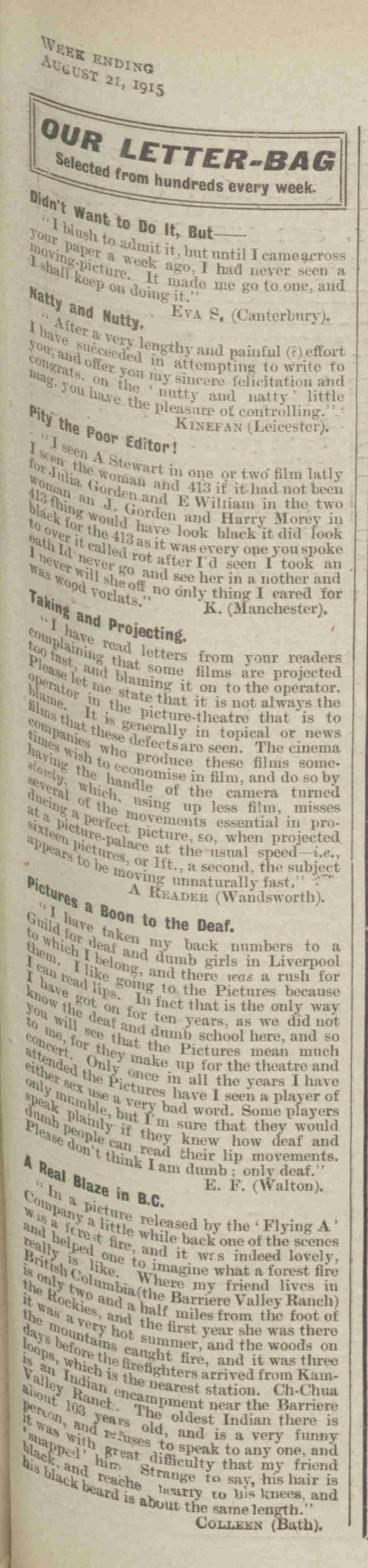
And there are always those incidental (non-Buchanan related) delights like this. Who knew the actors in Silent Movies occasionally swore?!
|
 |
|
|
 |
 |
 |
|
The only other thing worth a mention is The Speaker, a magazine I had not come across before. I don’t think they were fans of Buchanan. In the issue of 26th September, 1891, there’s a very tongue-in-cheek review of The Outcast, and a review of The Coming Terror in the issue of 18th April, 1891 concludes with this:
‘At present we are not concerned with the justice or absurdity of Mr. Buchanan’s views on human affairs. We have written merely to point out that the unhappy infirmity of his temper leads him to the frequent use of language which disgraces the page on which it is written; and to suggest that, if he must write at all, he might try to write like a gentleman.’
|
|